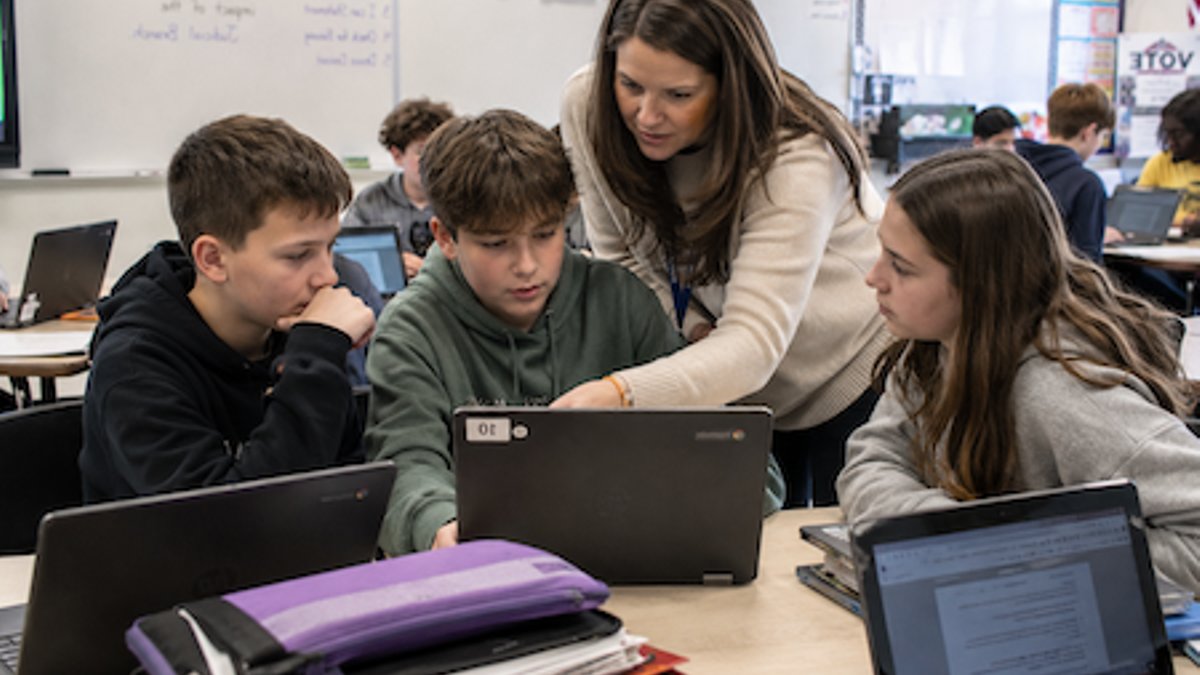
Artificial intelligence is becoming a daily reality in Illinois classrooms, reshaping how students research, problem-solve, and create. Now, Teach Plus Illinois and the Illinois Digital Educators Alliance (IDEA) are releasing “From ‘Rules and Tools’ to Schools,” a follow-up to a 2024 report that warned of unregulated conditions in schools.
Legislation and survey data guide the roadmap
The new report is built on a statewide survey conducted with a coalition of 15 organizations and comes amid momentum for Senate Bill 1920. This legislation directs the Illinois State Board of Education (ISBE) to establish statewide AI guidance this summer. The document offers policymakers a clear, classroom-grounded roadmap for regulating the technology.
“In 2025, Illinois teacher leaders led the way on artificial intelligence by passing SB 1920 and directing the Illinois State Board of Education to issue state-level guidance on AI,” said Bill Curtin, Teach Plus Illinois Policy Director. “Today, teacher leaders are providing the roadmap ISBE needs to ensure that guidance is grounded in classroom realities.”
Related: EdTech firm adds K-12 leaders to AI advisory board
Curtin added that because AI is always evolving, Illinois policy must be as adaptive as the technology itself. He emphasized that teachers must have a permanent seat at the table to ensure AI technology enhances student learning and human connection rather than replacing it.
The survey found that 58 percent of responding educators use AI for lesson planning. Nearly half use it to tailor instruction to individual students. Teachers see real promise, particularly for multilingual learners and students with disabilities, but are clear that AI must never replace the human judgment and relationships at the heart of good teaching.
Uneven access to training
Many educators are finding effective ways to use AI to enhance their work. Teachers are using AI to build more creative lessons, tailor content for multilingual learners and students with disabilities, give faster feedback on writing, and streamline administrative tasks. AI is changing schools faster than schools are developing guidance around using it well.
Related: Children forgetting a vital childhood skill
Access to training has grown since 2024 but remains deeply uneven. One in four educators reported no AI professional development at all. This gap creates a divide between districts that can afford robust training and those that cannot, potentially widening the achievement gap in the process. Kelly Torres, a Bensenville history teacher and Illinois Policy Fellow who is a lead author of the report, noted that educators are handling both the promise and the challenges of AI in real time.
“Educators are handling both the promise and the challenges of AI in real time,” Torres said. “This report raises what teachers are learning from their classrooms: AI can be a powerful tool for innovation and access, but only if it is implemented in ways that protect student thinking, academic integrity, and human connection.”
Guidance for the state board
The report provides specific recommendations for ISBE. It asks the board to provide concrete examples of best practices and inappropriate use. Teachers need specific, real-world examples of what responsible AI use looks like in an Illinois classroom. The document also calls for leveraging teacher leaders to support effective AI implementation. Trained teacher leaders can translate state guidance into everyday practice based on what students need.
Related: NEH funds cultural tech initiatives
Another recommendation is establishing a statewide framework for vetting AI tools. All schools, regardless of size or budget, should be able to choose products based on instructional value, student privacy, and equity. Finally, the report urges ISBE to position AI as a tool to support, not replace, human connection. Guidance must be explicit that AI cannot substitute for the mentorship, relationships, and human judgment at the core of teaching.
“Education is changing at a fast pace right now, and it will be important for teachers to focus on the processes and critical thinking that accompany learning rather than the end result,” said Dr. Traci Johnson, Executive Board President of Illinois Digital Educators Alliance. “It is critical that teachers are trained on how to make that shift, and ISBE is perfectly positioned to help all educators handle AI and its uses for education.”
The report reflects exactly what educators hear from classrooms. Scott Fraunheim, Chief Executive Officer of LEAP Innovations, said the state’s educators and students are ready to adopt AI as a tool for innovation. They deserve guidance that keeps pace with its rapid advancement. AI can also reimagine what student engagement looks like and shows that when educators are supported and trusted, AI becomes a catalyst for future-ready learning.





Leave a Reply